When McDonald’s Netherlands pulled its AI-generated Christmas ad after intense backlash, the company learned an expensive lesson about the gap between what AI-generated content can create and what humans will accept. Comments like “ruined my Christmas spirit” and dismissals of “AI slop” weren’t just complaints about poor execution-they were rejections of inauthenticity at scale.
This phenomenon-what researchers describe as an “AI-authorship effect” and what I call the authenticity premium-reveals a fundamental truth about AI and meaning that I explore in my recent TEDx talk. Recent studies in the Journal of Business Research confirm what we’re seeing: when consumers believe emotional marketing communications are written by AI rather than humans, they judge them as less authentic, feel moral disgust, and show weaker engagement and purchase intentions—even when the content is otherwise identical. Before we dive into the McDonald’s case and its implications, I want to share the framework that helps us understand why these rejections are happening.
]In my TEDxWaldenPond talk, “We Cannot Leave Meaning Up to Machines,” I explore the critical gap between what AI-generated content can do and what it can truly comprehend. The core insight: AI has been trained on our words, not our lived experiences.
Watch: “We Cannot Leave Meaning Up to Machines” | TEDxWaldenPond
At seven years old, sitting on a library floor holding a book, I realized something profound: the tension between the English word “book” and the Spanish word “libro” revealed that the thing itself exists apart from the word. Language is a tool we use to point at reality—but it’s not reality itself.
AI doesn’t know this. It can’t. Current AI systems operate on correlations in data; they lack consciousness, embodiment, or subjective experience. As philosophers studying LLMs have noted, while these systems can simulate empathy and understanding, they “neither truly understand nor authentically empathize”—understanding requires interpretive engagement with meaning that goes beyond statistical symbol manipulation. AI produces output that is statistically likely to be interpreted as meaningful, but that’s not the same as genuinely meaningful.
This distinction is exactly what’s playing out in the McDonald’s backlash.
The ad was statistically likely—it had all the hallmarks of a Christmas commercial (snow, warmth, nostalgia, family). But it lacked the lived experience of what those moments actually mean to people. And audiences felt that absence viscerally.
As I discuss in the TEDx talk, when we accept AI output uncritically, we confuse linguistic likelihood with lived experience. The McDonald’s ad—titled along the lines of “the most terrible time of the year”—depicted familiar holiday chaos: Santa stuck in traffic, a cyclist slipping in snow, gifts everywhere. The message? Escape to McDonald’s until January. Technically competent. Strategically sound. And yet, audiences rejected it viscerally. McDonald’s Netherlands confirmed to multiple outlets that it removed the ad and called the experience “an important learning” as it re-evaluates how it uses AI.
Why? Because when the stakes are emotional—holidays, grief, celebration, family moments—people don’t want “probably meaningful.” They want genuinely meaningful. And they can sense the difference.
The phrase “AI slop” has emerged as shorthand for low-quality AI-generated content flooding our digital spaces. But the McDonald’s backlash reveals something deeper: it’s not just about quality. It’s about the authenticity premium.
The production company defended their work, noting that “ten people worked full-time for five weeks” on the AI-generated ad. A critic from Bomper Studio responded: “What about the humans who would have been in it, the actors, the choir? Ten people on a project like this is a tiny amount compared to shooting it traditionally.”
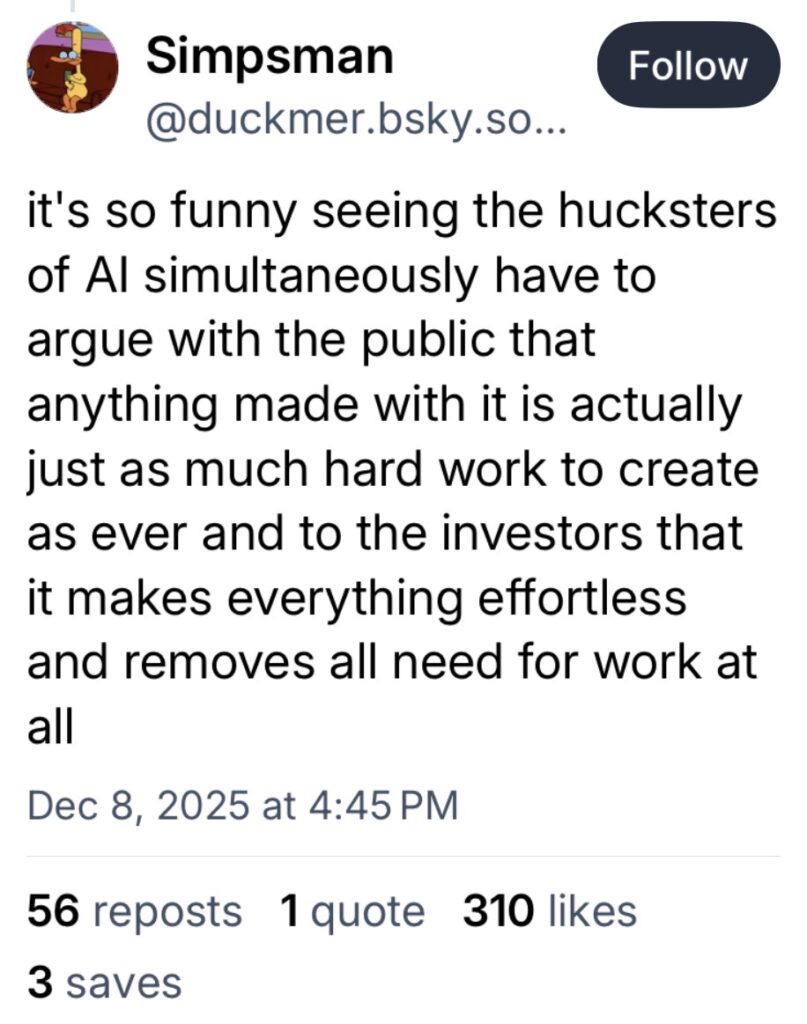
This exchange exposes a deeper problem-and the wider conversation playing out across social media captures it perfectly. As one Bluesky commentator wryly observed, AI promoters are caught in contradictory narratives: simultaneously arguing to the public that AI-generated content requires just as much hard work as traditional production, while pitching to investors that it makes everything effortless and eliminates the need for human labor entirely. You can’t have it both ways. And consumers are noticing the gap between the marketing claims and the economic reality. The authenticity premium reflects this recognition: in contexts where human creativity and genuine emotion matter, audiences reject content that feels like a cost-cutting exercise dressed up as innovation.
Not all AI-generated content faces this resistance. AI excels at pattern recognition, optimization, personalization at scale, and handling computational complexity. But McDonald’s and Coca-Cola (which has experimented with AI-driven holiday campaigns that drew criticism for feeling gimmicky or inauthentic) are learning what many organizations will soon discover: there are contexts where AI-generated content actually subtracts value rather than adding it.
Holiday advertising is inherently about connection, tradition, and shared human experience. When brands deploy AI in these spaces, they’re essentially saying: “We optimized for production efficiency over the human craft that might actually resonate with you during this emotionally significant time.”
Consumers hear that message loud and clear. And increasingly, they’re rejecting it.
The framework from my TEDx talk helps us understand when and why authenticity premiums emerge. They appear most strongly in contexts where:
In these contexts, experimental and survey evidence suggests that AI authorship often creates what researchers call a “trust penalty”-lower trust, weaker engagement, and more negative brand evaluation. A 2025 study from the Nuremberg Institute for Market Decisions found that simply labeling an ad as AI-generated makes people see it as less natural and less useful, which lowers ad attitudes and willingness to research or purchase.
Both McDonald’s and Coca-Cola are massive global brands with enormous marketing budgets. They could have produced traditional holiday ads. They chose AI anyway.
Why? Presumably for cost savings, speed, creative control, or the ability to test multiple variations. All rational business reasons. But they failed to account for the authenticity premium-the intangible but very real value that human creativity provides in emotional contexts.
The financial cost of producing an AI ad versus a traditional shoot may favor AI. But when you factor in the risk of public backlash, content fatigue (Deloitte’s 2024 Connected Consumer Survey reports that nearly 70% of respondents are concerned AI-generated content will be used to deceive them), and lost chances for genuine connection in critical seasons, the apparent cost advantage of all-AI production quickly erodes. At least for now.
Here’s what the production company got right in their defense: “It’s never about replacing craft, it’s about expanding the toolbox.”
This distinction matters enormously. AI as a tool that amplifies human creativity, speeds up iteration, or handles technical execution while humans maintain creative direction? That’s promising. AI as a replacement for human judgment, creativity, and authentic expression in contexts that demand genuine meaning? That’s where we see backlash.
The most successful AI implementations I’ve observed follow this pattern: humans set the vision, values, and creative intent. AI handles execution, optimization, and scale. The human touch remains visible and valued. Marketing case studies consistently argue that AI should handle data, pattern detection, and iteration, while human creatives provide emotional framing, context, and values to ensure content resonates authentically.
In my TEDx talk, I share a practical three-step framework for engaging with AI-generated content in a way that helps us distinguish between statistical probability and meaningful insight:
1. Un-name it: Look past the labels and surface features to see what’s really underneath. Don’t just accept “Christmas ad” or “holiday campaign” at face value. What is this content actually doing? What patterns is it following?
2. Experience it: How does it make you feel? What’s your gut reaction? The McDonald’s audience experienced visceral discomfort—”ruined my Christmas spirit”—before they could articulate why. That felt sense matters. It’s telling you something important about the gap between linguistic likelihood and lived experience.
3. Connect it to what matters: Ask what human need this is supposed to serve, and whether it actually serves that need. Holiday advertising is meant to create connection, evoke shared memories, celebrate traditions. Does AI-generated content serve those deeper purposes? Or does it just mimic the surface patterns while missing the substance?
When McDonald’s applied this framework after the backlash, they discovered that their “efficient holiday ad” was actually a message that said: “We optimized for production cost over the human craft that might resonate with you during an emotionally significant time.” That’s not the message any brand wants to send.
In my TEDx talk, I share a practical framework for engaging with AI-generated content—questions that help distinguish between statistical probability and meaningful insight. Applied to business decisions, these translate to:
Before deploying AI-generated content:
When evaluating AI adoption:
For long-term positioning:
This brings us back to the central question of my TEDx talk: How do we prevent AI from faking understanding so convincingly that we forget to ask what’s real?
Here’s the counterintuitive opportunity: as AI-generated content floods the market, authentically human creativity becomes more valuable, not less.
When everyone can generate “good enough” content instantly, the brands and creators who invest in genuine human craft, thoughtful creative process, and authentic expression will stand out. The authenticity premium creates a moat that AI efficiency alone cannot cross.
This doesn’t mean rejecting AI. It means being strategic and intentional about where and how we deploy it-and equally intentional about where we preserve and celebrate human creativity.
McDonald’s pulled their AI Christmas ad. Coca-Cola continues testing boundaries despite backlash. Other brands are watching and learning.
The authenticity premium is real, measurable, and growing-grounded in documented trust penalties, the AI-authorship effect, and demonstrated bias in favor of human creativity. Surveys suggest that roughly half of consumers now believe they can recognize AI-written content, and many report disengaging when they suspect brands are relying on it too heavily, especially in emotionally meaningful contexts.
The brands that will thrive in the next decade aren’t those that use AI most extensively—they’re the ones that deploy it most wisely, understanding where it adds value and where it subtracts it.
The authenticity premium isn’t going away. If anything, it’s growing stronger as AI becomes more capable. The question is whether your organization will pay it—or earn it.
The McDonald’s case is just one example of a much larger pattern. In my TEDxWaldenPond talk, I explore:
Watch the full 13-minute talk: https://youtu.be/7fHjbqWRL4E?si=MDC6mjIZWHMVcDPE
If this message resonates with you, like the video, comment with your thoughts, and share it with leaders grappling with AI implementation. The conversation about AI and meaning isn’t optional anymore—it’s urgent.
Kate O’Neill is a strategic advisor known globally as “the Tech Humanist” who helps organizations make better technology decisions that prioritize human experience. Her latest book is What Matters Next: A Leader’s Guide to Making Human-Friendly Tech Decisions in a World That’s Moving Too Fast. Her recent TEDx talk is called “We Cannot Leave Meaning Up To Machines.”
The line between being a “Tech Humanist” as I define it and a tech ethics professional is pretty thin. My emphasis has been on...

Somewhere on my computer, I keep a collection of images of humans showing up in non-human contexts. These are contexts that are supposed to...
“In most of our cities and our nation, we don’t prioritize human life [….] We’re prioritizing traffic and the movement of vehicles.” Source: Zero...
The way strategists and designers theorize about human experience — and specifically customer experience, which is humans in the contextual role of “customer” —...
One of the themes shaping my work this year is “the future of trust and truth.” In an era characterized by disagreement over basic...
Scratch the surface of any debate about the future of work and you’ll find there an argument for Universal Basic Income. And certainly from...
As we head into 2020, I’m still obsessed with the integration of human experience. My work over the last two decades in technology has...

I’m reminded by my memories on Facebook (yes, I still have Facebook for a variety of reasons — that’s a separate post) that it...
“The first question I ask myself when something doesn’t seem to be beautiful is why do I think it’s not beautiful. And very shortly...
Rather, the most interesting things about Pokemon Go have to do with connected experiences, and the sweeping changes these are bringing: new marketing models, opportunities with...
I often work at coffee shops. A lot of other people do, too, of course. But since it’s my nature to think about meaning and...