The future may be unknowable, but it isn’t necessarily unpredictable. Either way, we can do our best to prepare for it.
For business leaders, predicting the future is essential to success. But it’s also difficult, which is why many rely on fortunetellers or soothsayers—or futurists, in today’s terminology. Luckily, there are other ways to predict the future: methods that are based on logic and evidence rather than magic. In this blog post, we’ll explore some of these techniques and how you can use them to your advantage.
Fortune-telling, in some form, has been around since 4000 bce in ancient China, Egypt, Chaldea, and Babylonia. Ancient Romans used birds; Greeks used fire; whether cultures used entrails, flour, tea leaves, or crystal balls, human history is chock-full of leaders seeking guidance from those who claim to be able to see what the future holds.
Today, futurists are called upon to advise C-suite teams and boards on emerging tech and cultural trends, deliver keynote speeches at industry conferences, and provide expert commentary on the news about trending topics and the big changes they may herald. I should know: that last sentence is basically my job description.
In my mind, though, I’m a strategist, not a futurist. But a savvy strategist is paying attention to what has been trending, why it appears to be trending, and where it looks like it might go next. So yes, a strategist at least dabbles in futurism.
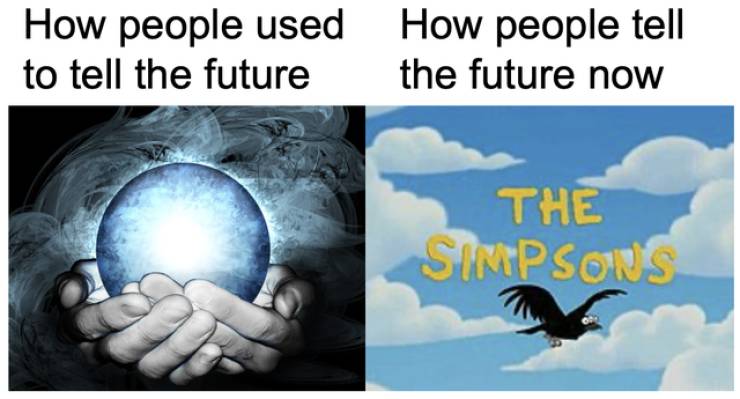
And these days I do more than dabble, as “future of X” research informs the bulk of my advising and speaking. Whether that “X” is “work,” “education,” “cities,” or any of a handful of other topics, I’m tracking trends that relate to it and looking at them across dimensions of other industry and extra-industry change factors. In other words, I have my eye on a lot of news. (Or a lot of Simpsons. I’ll never tell.)
Besides, while business magazines still write about digital transformation, I maintain that future transformation is actually the more relevant focus. Transforming so that you’re ready for the future will inevitably involve some digital transformation, but it will almost certainly also entail cultural adaptations, behavioral changes, and more.
The future is always uncertain, but that only means we can’t know it for sure. That doesn’t mean we can’t try to predict what’s going to happen.
We can — and frequently should — use our best guesses to try and anticipate what lies ahead. Through thoughtful analysis of past and current trends, resources, and technology, we can make informed predictions about the future and plan accordingly. It’s not an exact science by any means—after all, it’s impossible to know what life may throw at us next—but doing our best to keep an eye on the horizon gives us an opportunity to actively shape our paths going forward. The future may remain uncertain, but that doesn’t mean we can’t do our part to make sure it goes the way we want it to.
Making educated guesses about the future is not only an interesting exercise, it can soon become a way of life. And sometimes your guesses will be incredibly accurate! By studying the past, looking at current developments, and reading into potential changes, we can make intelligent assumptions on what tomorrow may bring us. We can use trends, global events, and even emerging technologies to see where our world might head in the near-term. Fortunes have been made in the stock market due to making timely predictions based on future insights – it’s possible for more than just financial gain to come from this activity! Becoming educated on socio-economic shifts and recognizing patterns can provide a positive outlook for the future as well and help us prepare for what’s ahead.
By the time a trend topic hits the news, it’s usually been bubbling up for a while. If there are platforms behind the trend, it might mean there’s a movement afoot. If there are behavioral changes needed to embrace the trend, it faces a question of critical mass and momentum. If there are concerns with safety, privacy, or other harm to users, consumers, or whatever role people are in, there’s a matching policy discussion needed that will inevitably take too long to play out.
It’s always interesting to track a trend, but when it comes to predicting where it will go next, there are two main options: a retro rollback or a forward leap.
The trend watchers among us can identify these happenings, then dig deeper. It’s up to each of us to think about what those signals may mean for the future and how you can use them to inform decision-making in your own life or organization.
Life doesn’t offer many guarantees, but one thing you can count on is that emerging technologies will continue to revolutionize our lives as time passes. With a constant influx of new inventions and discoveries, we must ask ourselves what the limit for technological advancements may be. We can be sure that with emerging technologies, such as artificial intelligence, augmented reality, and autonomous cars, the future promises great leaps in technology that could make many of today’s innovations look quaint by comparison. As the world continues its march into tomorrow, it becomes increasingly clear that technology is a journey rather than a destination of its own.
Rapid shifts in culture and technology challenge the status quo and often make it harder for us to predict the future with any confidence. But those same shifts also give us the opportunity to see trends and changes coming further out than ever before.
Autonomous vehicles, for example, represent a major force with a lot of R&D and a lot of infrastructural investment behind it. So are electric vehicles and other responses to carbon emissions. Those are two massive trends converging in the automotive, trucking, and transportation industries. At some level, it’s not a matter of “if” but “when,” and what effects do the likely changes have on future planning for your own industry and your company’s products and services.
The best way to anticipate the big changes is to look at what’s been trending over the last few weeks or months, identify commonalities or patterns, and ask “what if” questions about them. Evaluate a range of likely scenarios based on the evidence you’ve found, and then prioritize which ones you’re going to track more closely.
As humans, we are impacted by events that occur around the world on a daily basis, whether what happens is positive and beneficial or has destructive consequences. From political elections to a pandemic sweeping across continents and affecting millions of people in its wake, global events have consistently proven their singular power over our lives by transforming the way that societies operate and how individuals interact with each other, for better or for worse. This phenomenon is neither static nor dormant but rather the result of an ongoing exchange between the past, present, and future. As things continue to evolve in our interconnected world, it’s up to us as global citizens to grow alongside them and agree upon how these developments should be handled responsibly.
As human beings, our lives are constantly in transition. As we get older and the world around us changes, so do our personal experiences. Those new moments of growth and awareness bring us a sense of depth and perspective that can add meaning and purpose to our human lives. It is through these small revelations that we understand more of who we are at our core. Even if they seem small now, they have tremendous potential to shape our human experience.
As leaders, our jobs are to align our work with what is relevant today and tomorrow, and what will be relevant for our customers tomorrow as well.
Predicting the future isn’t an exact science. No matter how educated our guesses, we should always be prepared for the truly unexpected. Predicting a range of outcomes — good and bad — can help us better prepare.
Forecasting requires that we be both data watchers and imaginative thinkers — using our creative eye to spot trends and patterns, while ready to adjust our view of the future as trends continue to play out.
Everything we do shapes the possible future. Our choices today can have a ripple effect that lasts far longer than we imagine. By staying aware of trends and understanding how they could impact our lives, we gain the power to make informed decisions that create a better future for ourselves and others.
You’ll never have a perfect system for prediction, but with the right approach you can get a good idea of how your world is likely to look in weeks and months to come — providing the opportunity to take advantage of new opportunities or make the necessary preparations for any rough patches on the horizon. By viewing current events through this lens, we can gain a unique perspective that allows us to stay ahead of the curve.
Good luck, and may our future be bright.
When people ask me about the future—especially when it comes to technology, business strategy, or organizational transformation—they often want predictions. Clean, confident statements about...
I. Introduction: Why Strategic Foresights Matter More Than Trends (And Why We’re Publishing This in June) A. Breaking the Year-End Prediction Cycle Every December,...
An Analysis Through the Models of Tech Humanist, Pixels and Place, A Future So Bright, and What Matters Next Your phone buzzes at 6:47...
Water is the essence of life, and yet, it’s a resource that is often taken for granted. With climate change and industrial growth putting...
What is the Future of Work? As we step into 2024 and beyond, the conversation around work, jobs, and the workplace continues to evolve....
The Economist has an interesting read on the metals shortage the world faces: https://www.economist.com/finance-and-economics/2023/09/11/how-to-avoid-a-green-metals-crunch “By the late 2030s there will probably be enough new...

Nothing changes faster than the trends you haven’t been paying attention to. But in the past few years there’s been SO MUCH OTHER STUFF...
When I launched this company in 2014, I chose the word “insights” with intention. I thought of it as my duty to my clients...
Ah, 2021. The year we’ve been looking forward for the entire century that was 2020. Rationally, we know the calendar year is an arbitrary...
This time of year is my absolute favorite because for me it’s so much about relaxed reflection and setting intentions for the year —...
I’ve been fortunate enough to make my living writing, speaking, and advising about the impact of technology on humanity for quite a few years...
By now it seems everyone and their dog has shared their predictions and observations about the the trends of 2015, so it may seem...