Today is National Optimists Day, apparently. (I mean, there’s a day for everything.)
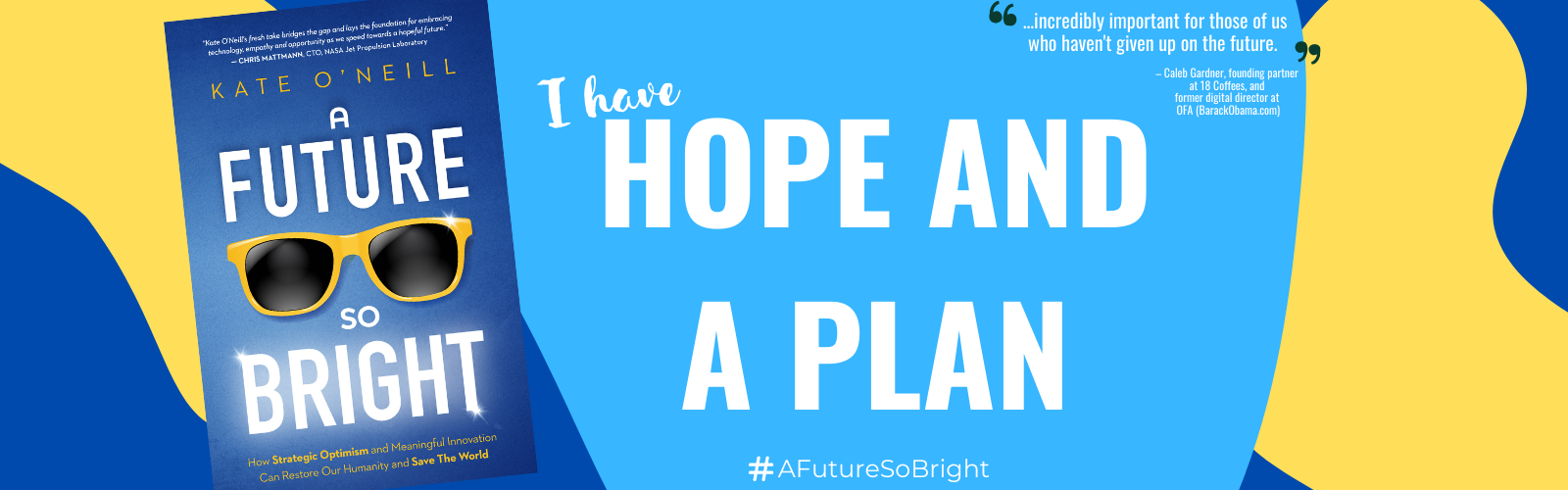
In honor of the, uh, holiday(?), I wanted to address a point of confusion that has surfaced in a few of my media interviews since launching A Future So Bright. People latch on to the word “bright” in the title as well as “optimism” in the book’s subtitle (“How Strategic Optimism and Meaningful Innovation Can Restore Our Humanity and Save the World”) and they tend to overlook the all-important word “strategic” — not to mention the “meaningful innovation” bit, which is a necessary piece of the solution.
In other words, there seems to be a temptation to reduce the entire discussion to something like “looking on the bright side of life.” And hey, I can certainly own that a good deal of the fault here lies with me for titling the book that way. But there’s so much more to this book than the reductive idea of “looking on the bright side.” Rather than gloss over the darkness and the problems in the world, the ideas in the book are intended to help us face those challenges and still create the brighter future we’d like to see. So here on National Optimists Day, I’d very much like to clear up this misunderstanding.
Because so many discussions about what it means to be optimistic veer into the realm of what is often referred to as “toxic positivity.” And when it comes to technology, optimistic views too often lead to a mindless kind of techno-optimism, or techno-utopianism. None of this is actually helpful.
What IS helpful is to blend an optimistic view of what’s possible with a strategy for how to get there. Strategic Optimism, as I call it. That way we see the best of what we can achieve, and we get to work, with a plan, to make it happen. It’s an active process. All the while, we acknowledge what can go wrong and work to prevent the risks and harms from happening. But our focus — and our effort — stays oriented toward the best outcomes.
So think of this as a gift in celebration of National Optimists Day, if you like: I’ve decided to share below a good chunk of what I wrote about optimism — and specifically about my model of Strategic Optimism — in A Future So Bright, free for you to read right here. (And of course, after that you are welcome to go buy the book.) I’ve even added boldface emphasis in a few places to help you skim if you just want to get the broad strokes.
Let’s have a look:
Optimism gets a bad rap. […] So for reasons I’ll lay out here, the position I’m taking is clear-eyed, determined optimism with a commitment to follow-through, and it’s the stance I hope you’ll take alongside me before you’re finished reading this book.
The problem with optimism has been that instead of wielding it as a powerful tool for envisioning and working toward the best outcomes, people roundly mock it as a folly of the naïve. Historically, optimism in literature and philosophy has been dismissed as unthinking, unserious, unintellectual. And when they aren’t being ridiculed, optimists are scorned for willfully ignoring real harms.
But what about the advantages of looking at the bright side? A savvy approach to optimism can help us avoid the kind of failure that comes from not thinking about what might happen if things go better than we planned. And when it’s used properly and paired with the right tools, as I’ll explain in this book, optimism can actually help us acknowledge the whole truth of our circumstances, direct our focus, and align our efforts toward the best way forward.
Optimism doesn’t have to be simple-minded, shortsighted, or unaccompanied by rationalism. So yes indeed, there is a way to harness the power of optimism so that it is as clear-eyed as possible, as strategic as possible, as inclusive as possible, as aligned with success as possible, as actionable as possible, and as achievable as possible. That is the only optimism worth having, and it is the approach this book lays out.
[…]
The best way—perhaps the only way—to build a bright future is to challenge ourselves to envision the best future possible for the most people while at the same time acknowledging the ways the future could go dark and working to prevent that from happening.
Looking at what can go right as well as what can go wrong is a key part of what I call the Strategic Optimism Model. […] What this approach asks of us, in short, is to look at the whole picture, acknowledge the risks and the potential harms, and then actively work to mitigate them as we steer toward the most helpful, most meaningful outcomes.
The biggest obstacle in front of us? We’ve been taught to think about and talk about the future in too limited a way. Dystopia versus utopia? That’s more than useless; it’s dangerous. The falseness of that dichotomy (which we’ll explore in Beyond “Dystopia versus Utopia“), the dismissal of utopia as impossible, and the resulting despair of being left to accept an ever-encroaching dystopia keeps us from focusing on and addressing what we can actively do every day to ensure tomorrow is better than today, and next year is better than this year. It’s time to disrupt dystopia and give ourselves the freedom to imagine the bright future we really want to create.
— O’Neill, Kate. A Future So Bright: How Strategic Optimism and Meaningful Innovation Can Restore Our Humanity and Save the World. KO Insights.
Got that? Good. Feeling fired up? Even better. Here’s some more:
Let’s start with what Strategic Optimism is not:
Strategic Optimism is not “the power of positive thinking.”
Positive thinking is appealing for many and arguably important as guidance for aligning resources and focusing efforts. But I find its most devout adherents often take its application too far and apply it too literally.
It can quickly turn into an ugly case of victim blaming—as in, if you don’t have everything, you must not be thinking positively enough. For example: Got cancer? Why don’t you just think your way out of it?
That’s not at all the mindset we’re looking for here. Where the positivity principles do make sense is in aligning with our experience. The key is that framing our goals in terms of positive outcomes as opposed to negative ones—e.g., “I want to be wealthy” instead of “I don’t want to be broke”—generally lends itself to a stronger overall ability to focus and rally resources. It makes a very simple kind of sense: There is momentum in the positive, whereas the negative is all about stopping, and there’s no forward motion in that. Life is all about forward motion, so it’s practical to use a mental model that aligns with our experience and feels like it accompanies us as we move through time and space.
It’s not a matter of “law of attraction” or “power of positive thinking,” but rather of accepting that perceived limitations change our actions. If we let our beliefs limit us, we are guaranteed not to try.
Strategic Optimism is not about ignoring the limitations, risks, or harms that do exist; in fact, it’s about acknowledging the full reality of the current situation and the full range of possible outcomes, mitigating the worst outcomes, and working diligently toward achieving the best.
So what is Strategic Optimism, then?
The best results come about when we not only visualize the best possible future but also make a plan to commit ourselves to achieving it. This by necessity entails some variation of making goals, creating timelines, and sticking to them. In other words, developing some kind of strategy to achieve what you are hoping for.
Laying out a plan also means acknowledging the risks and harms that could occur and developing more plans to mitigate those, but also spending time on the ways the plan could go right and investing effort in ensuring those positive results come to fruition.
When we lay out our plans for the future, we know that we need to acknowledge the risks, but we often forget to spend as much time thinking about the opportunities. This can actually cost us: We might underestimate how successful a new product could be, for instance, and fail to have a way to meet demand; we might negotiate well below the value of our contributions in a job or a project; we might be so preoccupied with worst-case scenarios that when our moment to shine takes us by surprise, we’re fully unprepared for it.
— O’Neill, Kate. A Future So Bright: How Strategic Optimism and Meaningful Innovation Can Restore Our Humanity and Save the World. KO Insights.
The Importance of Strategic Optimism
It’s hard to overstate how helpful optimism with a strategy can be — while at the same time it’s hard to overstate how harmful it is to allow the above to be oversimplified and made into positivity without a plan.
Throughout my research, I kept encountering quotes about optimism. Some of them resonated, some very much did not. This discussion brings me back to one of the two quotes that I chose to the open the book, which spoke to me the most:
“My optimism wears heavy boots and is loud.”
— Henry Rollins
My optimism brings a strategy. How about yours?