When people ask me about the future—especially when it comes to technology, business strategy, or organizational transformation—they often want predictions. Clean, confident statements about what will happen next.
But here’s the uncomfortable truth: making predictions is actually the opposite of future-readiness.
Future-readiness isn’t about guessing right once. It’s about building the capacity to sense change, interpret patterns, and respond effectively—no matter which version of the future unfolds.
Predictions feel reassuring. They offer the illusion of control in an uncertain world. But they’re fundamentally different from the kind of strategic preparation that helps leaders and organizations actually thrive amid change.
Let me show you what real future-readiness looks like—and why it matters more than ever.
Humans are wired to dislike uncertainty. Predictions scratch that itch by offering false certainty—a single, confident answer to complex, evolving questions. They’re more parlor trick than strategic tool.
Don’t get me wrong: you need informed hunches about likely outcomes. But publicly committing to specific predictions often closes off the very thinking you need to stay adaptable.
Real preparation for the future isn’t about being right once. It’s about building the capacity to respond effectively no matter which version of the many possible futures actually begins to take shape.
Future-ready organizations don’t predict. They prepare through continuous, disciplined foresight work:
Let’s break down each practice.
Weak signals often appear as headlines—but not every headline is a signal worth tracking. The key is learning to spot the difference between noise and meaningful early indicators.
On one particular morning, these were the three most popular stories in my feed reader:
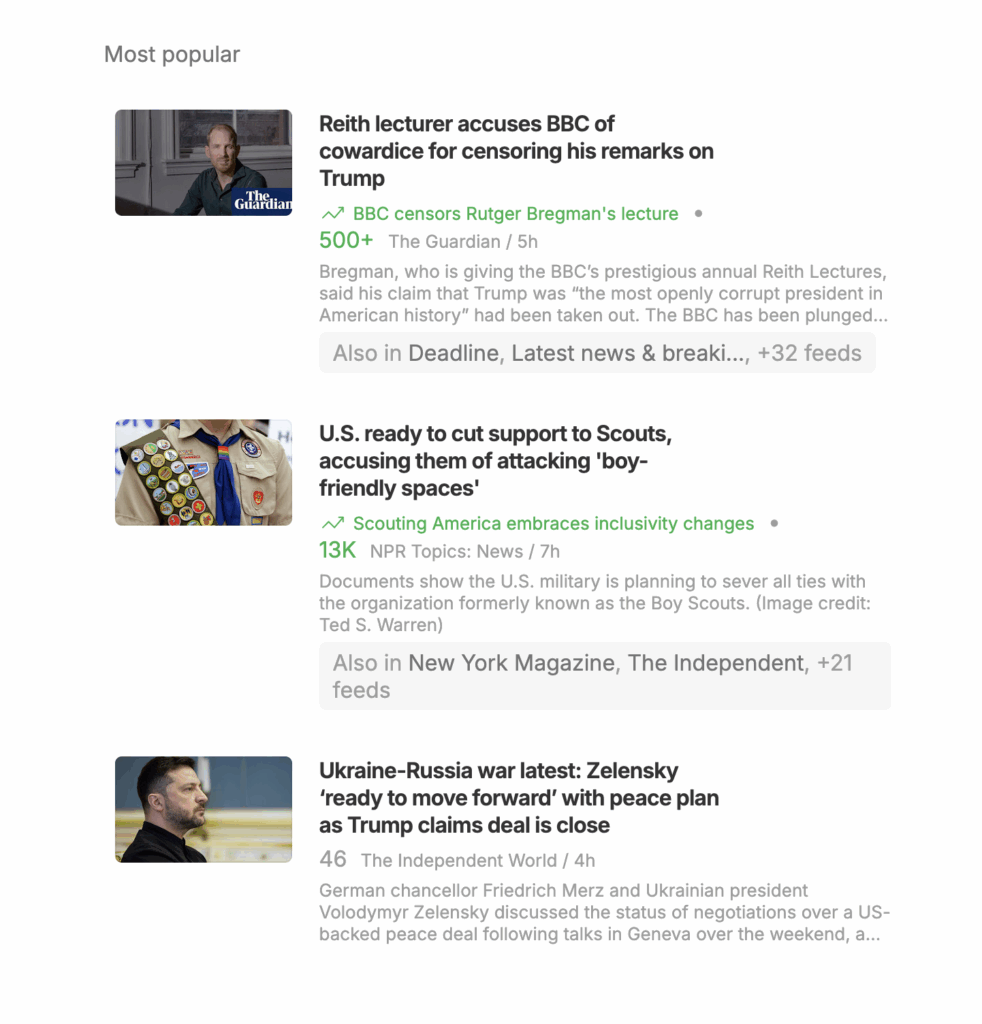
All three are newsworthy. But only one qualifies as a true weak signal using my criteria. A meaningful signal:
The Scouts story checks every box. It reveals how culture war politics are reshaping even the most established institutions—a pattern that will likely touch everything from schools to corporate HR policies to community organizations.
The other headlines? Important, yes. But they’re developments in ongoing stories, not early indicators of something new emerging.
Individual signals are interesting. Patterns between signals are where strategic insight lives.
Look for common themes and overlapping topics across your signals. But also watch for unexpected relationships—the connections that reveal something new about how the world is changing.
For example: you might notice fashion trends referencing the mid-2000s while simultaneously seeing social media discussions unpacking that era’s problems—particularly how harshly the media treated young female celebrities. Taken together, these signals suggest a “2000s resurgence and reckoning” pattern worth tracking.
At this stage, you don’t need to know why a pattern matters, or even why you’re drawn to it. Just that a pattern exists. These connections help you see not just individual events, but the larger forces at work beneath the surface.
Once you’ve identified patterns, the work becomes strategic: What might these patterns mean for different stakeholders? How could they reshape industries, behaviors, or social norms?
This is where you transform observation into foresight—into insights that can actually inform decisions.
Ask:
This is the bridge from noticing change to preparing for it.
Yes, this step still involves prediction—you’re casting forward and imagining how the patterns you’ve spotted might change the world. But instead of making one bold prediction, you think through a range of possible outcomes.
If you’re intellectually honest, one or two scenarios will feel most likely given current momentum. That’s your most likely scenario—the future you’d expect if current trajectories continue.
But you’ll also have a preference for how you’d like things to unfold. That’s your most preferred scenario—the future that best aligns with your values and goals.
The strategic question becomes: What decisions and actions would move the most likely future closer to your most preferred future?
That’s where your agency lives—not in predicting correctly, but in shaping outcomes intentionally.
Future-readiness isn’t a one-time exercise. It’s a practice—an ongoing discipline of attention and sense-making.
Keep three running lists:
Yes, that’s a lot of lists. But the investment pays off. Over time, reading headlines stops feeling like being surprised by the world. Instead, it becomes a way of deepening your understanding—and your strategic positioning.
Let’s return to my original claim: “Making predictions is actually the opposite of future-readiness.”
Predictions close down possibility. They anchor you to a single outcome and make you emotionally invested in being right. This investment blinds you to emerging information that could—and should—evolve your thinking and sharpen your readiness.
Future-readiness opens up possibility. It helps you see multiple paths forward and position yourself to act effectively no matter which path unfolds.
The leaders and organizations that thrive through change aren’t the ones who predicted correctly. They’re the ones who built the capacity to sense, interpret, and respond—continuously.
They don’t try to be right once. They build systems for being ready, always.
If your team or organization needs to move faster while staying grounded in what matters most, KO Insights can help.
Strategic Foresight Workshops Equip your leadership team with the frameworks and practices to track signals, identify patterns, and develop actionable scenarios. Half-day to multi-day formats available.
AI Strategy Advisory Navigate AI transformation with a human-centered lens. We help you align technology decisions with your strategic priorities and organizational values—building what I call “ethical acceleration.”
Keynotes & Speaking Bring these ideas to your next conference, board meeting, or company gathering. Kate O’Neill delivers engaging, thought-provoking talks on future-readiness, AI strategy, and human-centered transformation.
Executive Advisory One-on-one strategic counsel for founders, executives, and board members navigating inflection points.
Ready to move from prediction to preparation? Build your organization’s future-readiness with strategic foresight practices that help you thrive through change. Contact KO Insights to explore how we can support your team.
Or join the conversation: What’s one weak signal you’re tracking right now? Share this on LinkedIn and tag Kate O’Neill—I’d love to hear what you’re seeing.
I. Introduction: Why Strategic Foresights Matter More Than Trends (And Why We’re Publishing This in June) A. Breaking the Year-End Prediction Cycle Every December,...
An Analysis Through the Models of Tech Humanist, Pixels and Place, A Future So Bright, and What Matters Next Your phone buzzes at 6:47...
Water is the essence of life, and yet, it’s a resource that is often taken for granted. With climate change and industrial growth putting...
What is the Future of Work? As we step into 2024 and beyond, the conversation around work, jobs, and the workplace continues to evolve....
The Economist has an interesting read on the metals shortage the world faces: https://www.economist.com/finance-and-economics/2023/09/11/how-to-avoid-a-green-metals-crunch “By the late 2030s there will probably be enough new...
The future may be unknowable, but it isn’t necessarily unpredictable. Either way, we can do our best to prepare for it. Executive Summary: For...
Nothing changes faster than the trends you haven’t been paying attention to. But in the past few years there’s been SO MUCH OTHER STUFF...
When I launched this company in 2014, I chose the word “insights” with intention. I thought of it as my duty to my clients...
Ah, 2021. The year we’ve been looking forward for the entire century that was 2020. Rationally, we know the calendar year is an arbitrary...
This time of year is my absolute favorite because for me it’s so much about relaxed reflection and setting intentions for the year —...
I’ve been fortunate enough to make my living writing, speaking, and advising about the impact of technology on humanity for quite a few years...
By now it seems everyone and their dog has shared their predictions and observations about the the trends of 2015, so it may seem...